Why Qualified Candidates Get Rejected Before the Interview
Few experiences during final-year engineering or degree studies are more frustrating than submitting dozens of job applications and receiving complete silence in return.
You maintained a respectable CGPA, built semester projects, completed online certifications, and applied to openings announced on your college Training and Placement Cell (TPO) group or on portals like Naukri, LinkedIn, and Internshala. Yet weeks pass without a single interview invitation.
The reality of entry-level hiring in India is governed by extreme application volume. When mass recruiters like TCS, Infosys, Wipro, Cognizant, or Accenture launch a national hiring drive, or when a mid-sized product startup posts a junior opening on LinkedIn, thousands of candidates apply for a handful of openings.
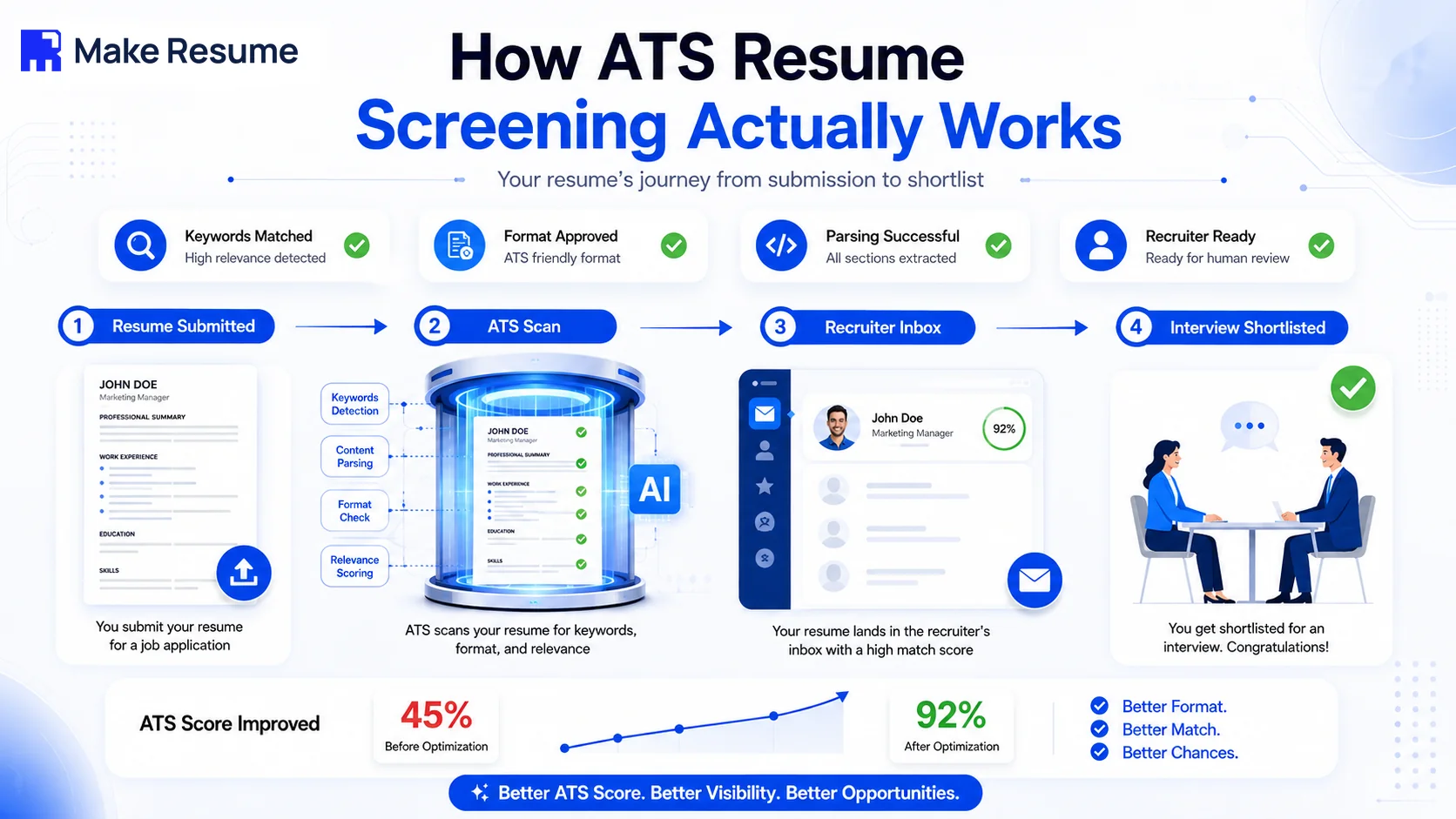
Recruiters cannot spend ten minutes analyzing each applicant's background. Instead, applications undergo a two-phase filtering gauntlet:
- Phase 1: Automated ATS Parsing and Algorithmic Ranking. Applicant Tracking Systems parse resumes, extract text into structured database fields, match keywords against role descriptions, and assign compatibility scores. Documents with parsing errors or low keyword density are discarded programmatically.
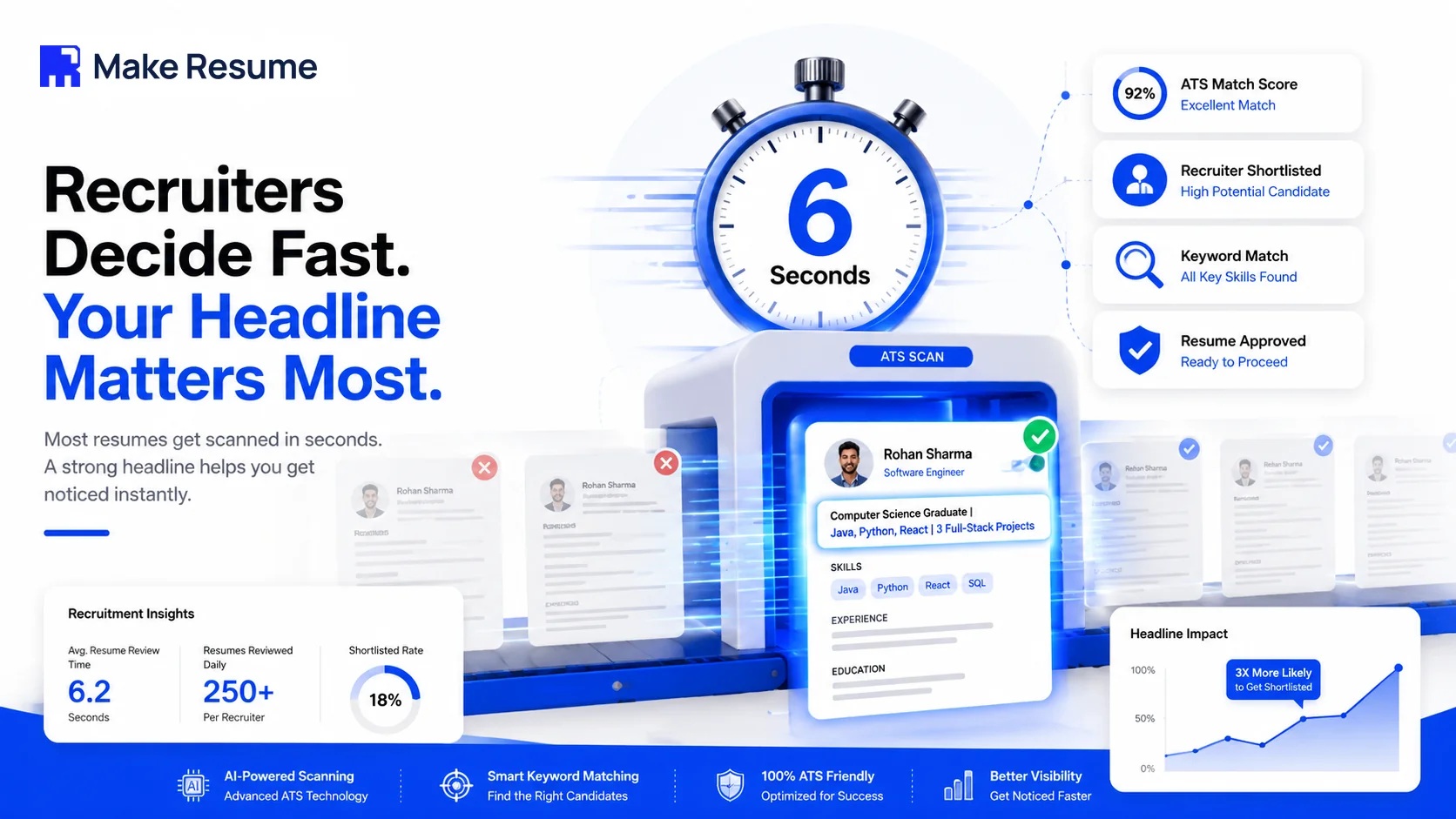
- Phase 2: The 6-Second Recruiter Visual Scan. If your resume clears the automated filter, a human talent acquisition screener spends an average of six seconds scanning the top third of the page for clear job title alignment, primary technical tools, and measurable achievements.
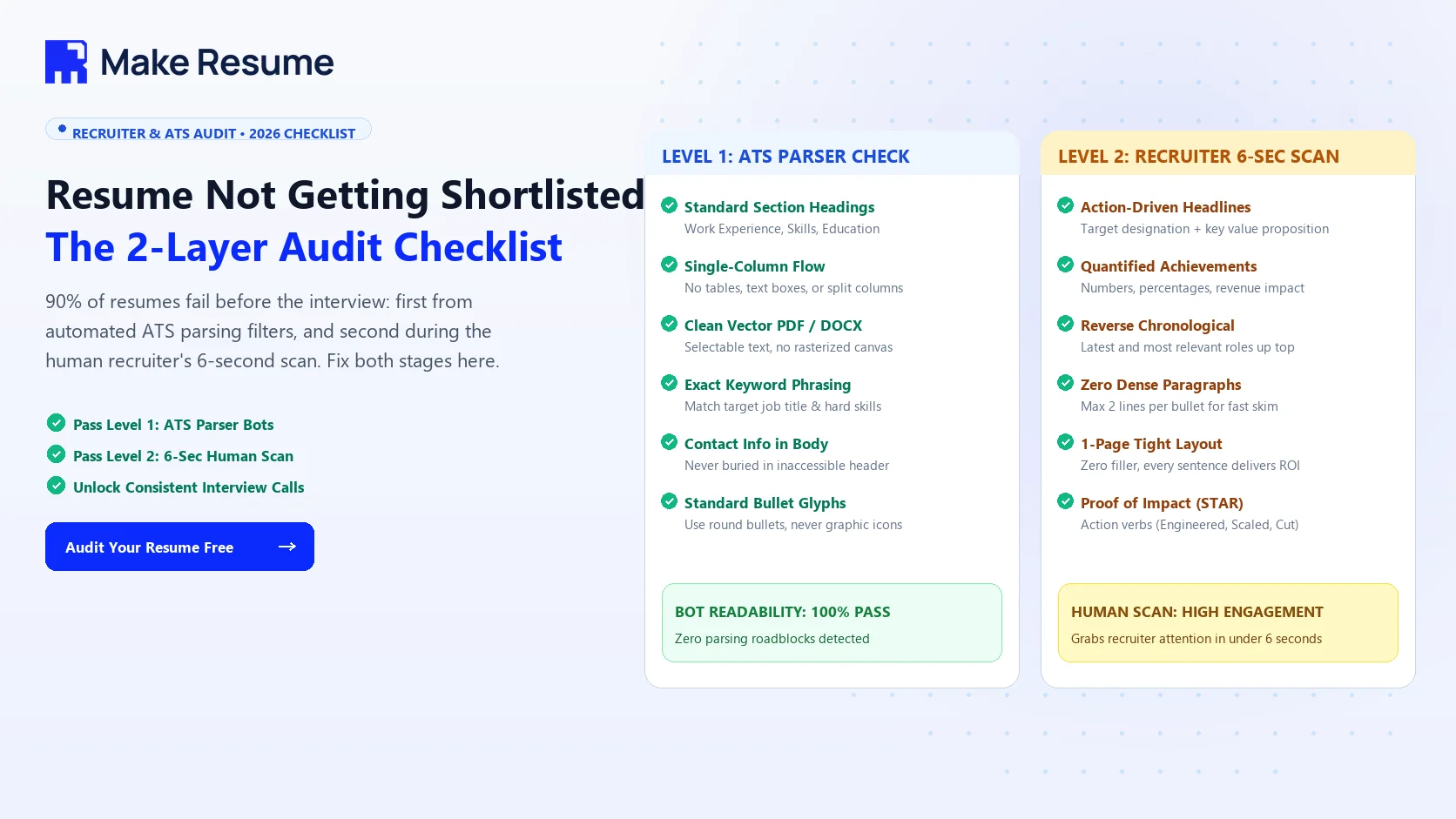
If your resume fails either phase, your application is rejected automatically. This 15-point diagnostic checklist isolates and fixes the exact failure points in your current resume draft.
The 15-Point Diagnostic Checklist
Section 1: Automated ATS Compliance (Checkpoints 1 to 5)
                    │
                    ▼
Section 2: Content, Skills & Academic Relevance (Checkpoints 6 to 10)
                    │
                    ▼
Section 3: Recruiter Readability & Impact Proof (Checkpoints 11 to 15)
Section 1: Automated ATS Compliance (Checkpoints 1 to 5)
1. Is your document formatted in a strict single-column layout?
Multi-column layouts are the number one cause of parsing failure. When an automated parser reads a two-column PDF, it reads horizontally across both columns. The first line of your Left Column merges with the first line of your Right Column, creating scrambled text. Always use a clean single-column structure from our tested ATS resume templates.
2. Are contact details placed in the main body instead of headers or footers?
Many enterprise parsers (including Taleo and Workday) ignore headers and footers to avoid processing repetitive page numbers. If your phone number, email address, or LinkedIn profile is placed inside Word or PDF header margins, your profile appears in recruiter databases with zero contact information.
3. Have you used universally recognized section headings?
Applicant tracking systems map text to database fields using strict string matching on headings. Avoid creative labels. Use only:
- Education
- Technical Skills
- Academic Projects
- Work Experience (or Internships)
- Certifications
4. Is your PDF text-searchable rather than a flattened image?
Open your PDF in any browser or PDF reader and press Ctrl + F (or Cmd + F on Mac). Type your name or a skill. If the search tool cannot find the text, your file is an image-only PDF, which means an ATS scanner will extract zero words. Always export clean vector PDFs directly from a text-based builder.
5. Are dates and durations formatted consistently?
Parsers calculate total experience and recency of projects by reading date ranges. Use consistent formats such as June 2025 to May 2026 or 06/2025 to 05/2026. Avoid mixing conflicting conventions across different sections.
Section 2: Content, Skills, and Academic Relevance (Checkpoints 6 to 10)
6. Does your headline specify your target role rather than generic status?
Writing "Final Year Student" or "Seeking Opportunities" provides zero search signals. Replace it with an industry-specific headline: "Junior Full-Stack Developer | React, Node.js, PostgreSQL | B.Tech CS 2026".
7. Are your technical skills grouped into logical categories?
Do not dump twenty random technologies into an unformatted comma-separated block. Organize your skills into four distinct clusters: Languages, Frameworks and Libraries, Developer Tools, and Databases. This allows both ATS parsers and human screeners to verify your stack in two seconds.
8. Have you paired acronyms with full terms?
Different recruiters and ATS queries search for varying forms of technical concepts. Always include both:
- "Search Engine Optimization (SEO)"
- "Object-Oriented Programming (OOP)"
- "Natural Language Processing (NLP)"
- "Relational Database Management Systems (RDBMS)"
9. Is your CGPA or academic percentage stated with clear context?
Indian placement cells and enterprise recruiters frequently enforce strict academic cutoffs (for example, minimum 60% in Class 10, Class 12, and Graduation, or 6.5 CGPA with no active backlogs). State your score clearly: 8.35 / 10.0 CGPA (First Class with Distinction) or 78.2% Aggregate. If you have cleared previous backlogs, state only your final cleared aggregate.
10. Does your resume match at least 70% of the target job description keywords?
Before applying to any role, compare your resume text against the employer posting using our job description resume matcher. Verify that core technical terms mentioned in the requirements appear naturally in your Skills and Project descriptions.
Section 3: Recruiter Readability and Impact Proof (Checkpoints 11 to 15)
11. Do project bullet points start with strong action verbs?
Avoid passive phrases like "worked on", "handled", or "responsible for". Start every bullet with decisive engineering action verbs: "Architected", "Engineered", "Implemented", "Optimized", "Configured", "Deployed".
12. Are your accomplishments quantified using numbers or percentages?
Bullet points without metrics read like theoretical class assignments. Whenever possible, add scope numbers, user volumes, latency improvements, or test coverage percentages.
Weak Bullet (No Shortlist Signal):
- Built an online store with React and integrated payment system.
- Made the website fast and mobile friendly.
Strong Shortlisted Bullet (Google XYZ / STAR Format):
- Developed a full-stack e-commerce web platform using React, Node.js, and MongoDB, supporting 500+ simulated concurrent product requests.
- Integrated Razorpay payment API with secure webhook verification, achieving 100% test transaction reliability across 50 simulated purchase flows.
- Optimized image compression and implemented lazy loading, reducing total initial page payload from 3.2 MB to 850 KB.
13. Is your GitHub, LinkedIn, or portfolio link active and clickable?
For tech roles, recruiters verify project code. Include your live GitHub profile link and direct deployment URLs (on Vercel, Netlify, or Render) alongside project titles. Confirm all links work and open properly in an incognito browser window.
14. Does the resume fit cleanly on a single page?
For college students, freshers, and job seekers with under two years of experience, a multi-page resume is a major warning flag. Two-page resumes for entry-level applicants usually contain irrelevant high school details, hobbies, or spaced-out formatting that irritates recruiters. Keep all information on one tightly formatted page.
15. Have you eliminated personal pronouns and redundant declarations?
Never use "I", "me", "my", or "we" in a resume. Similarly, remove archaic declaration sections like "I hereby declare that all information above is true to the best of my knowledge" and personal details like marital status or religion. These outdated conventions waste valuable space and signal unfamiliarity with modern hiring standards.
Before and After: Candidate Shortlisting Overhaul
To illustrate how applying this checklist changes a candidate's outcomes, review this real transformation of a Tier-2 engineering student who went from zero callbacks to three placement interviews:
Resume Profile Before Audit (Callback Rate: 0%)
- Template: Canva two-column layout with blue sidebar, circular skill rating meters, and a profile photo.
- Headline: Fresh Graduate Seeking Software Engineering Roles.
- Skills Section: C, Java, HTML, CSS, JavaScript, Hardworking, Fast Learner, Problem Solving.
- Projects: Final Year College Project: Library Management System in Java. Created forms for book issues and returns.
- ATS Score: 38 / 100 (scrambled columns, zero quantified metrics, missing database keywords).
Resume Profile After 15-Point Audit (Callback Rate: 18%)
- Template: Single-column clean layout from MakeResume with 1-inch margins and standard section headings.
- Headline: Junior Full-Stack Developer | Java, Spring Boot, MySQL | B.Tech CS 2026.
- Skills Section: Categorized into Languages (Java, JavaScript), Frameworks (Spring Boot, React), Tools (Git, Postman), Databases (MySQL).
- Projects: Automated Campus Library Portal using Java, Spring Boot, and MySQL. Implemented role-based JWT access for 1,200+ students, reducing manual issue tracking time by 60%. Deployed backend on AWS EC2.
- ATS Score: 89 / 100. Shortlisted by two campus recruiters and one off-campus startup within three weeks.
How to Proceed if You Are Still Struggling
If your resume satisfies all fifteen checkpoints and you are still not securing interviews, the issue may lie in where and how you are applying:
- Optimize Your Naukri and LinkedIn Profiles: Ensure your online profiles mirror the exact skills and headlines present on your revised resume.
- Apply Within the First 24 Hours: Jobs posted on LinkedIn and Naukri receive over 50% of their total applications within the first day. Set alerts and apply early.
- Tailor for Target Roles: Review our 10-minute resume tailoring guide before submitting each application.
- Deep-Dive into Scoring Bottlenecks: Read our diagnostic report on why your ATS score is low and how to fix it.
- Get Professional Feedback: If you need an objective external review, explore our 1:1 expert resume review sessions to walk through your bullets directly with industry tech recruiters.