Why ATS Scores Drop on Indian Job Portals and Campus Drives
A low ATS score does not mean your academic credentials or engineering abilities are inadequate. In most cases, a low score simply means an automated Applicant Tracking System could not extract your skills and project details in the structured order it expected.
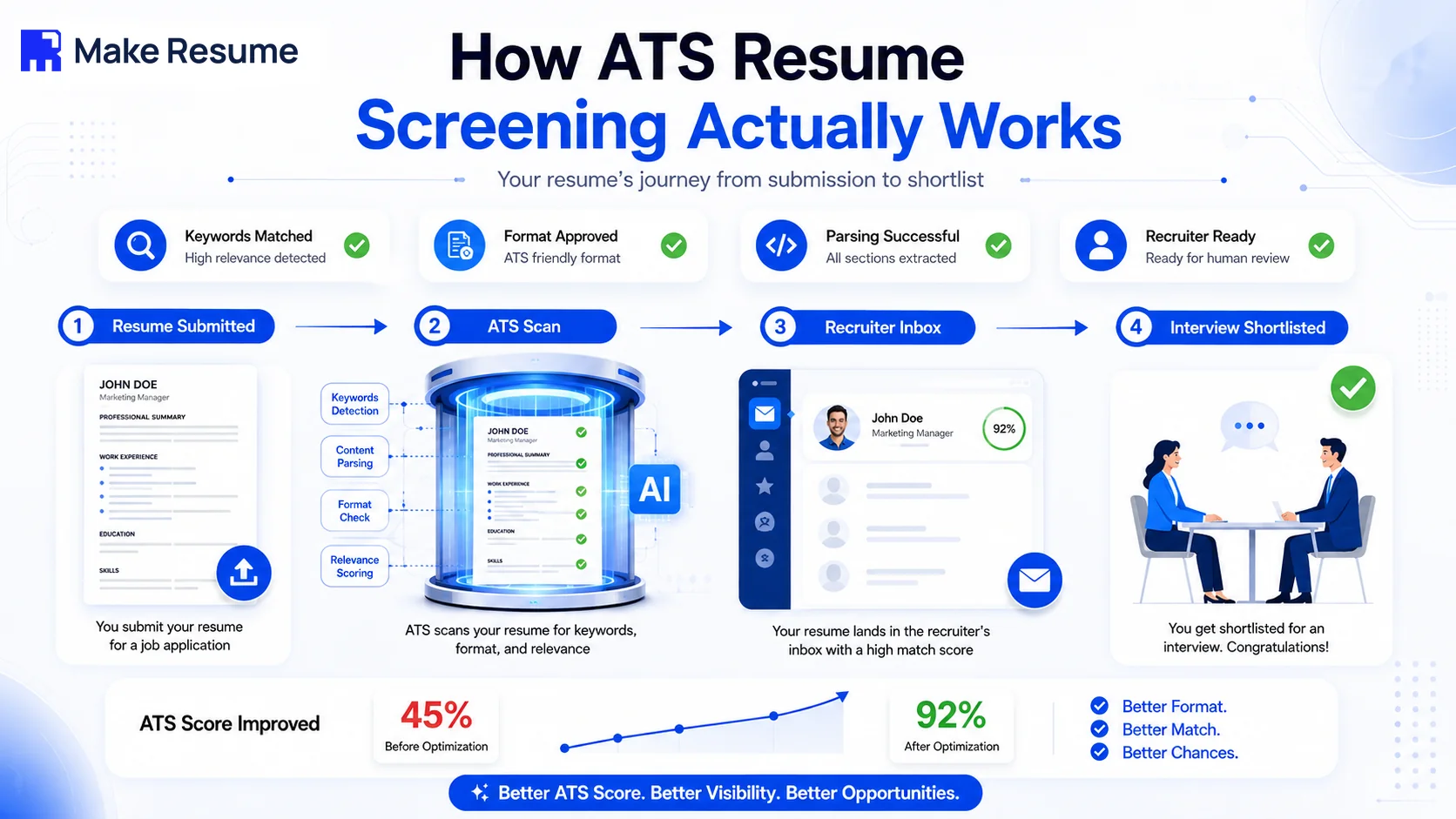
During placement season in Indian engineering, commerce, and management colleges, Training and Placement Officers (TPOs) upload candidate batches directly into enterprise recruitment portals. Companies like TCS, Infosys, Wipro, Cognizant, and Accenture receive tens of thousands of applicants per hiring drive. To manage this volume, recruiters rely on automated filters that parse incoming resumes, calculate an algorithmic relevance score from 0 to 100, and shortlist only the top percentile for technical interviews.
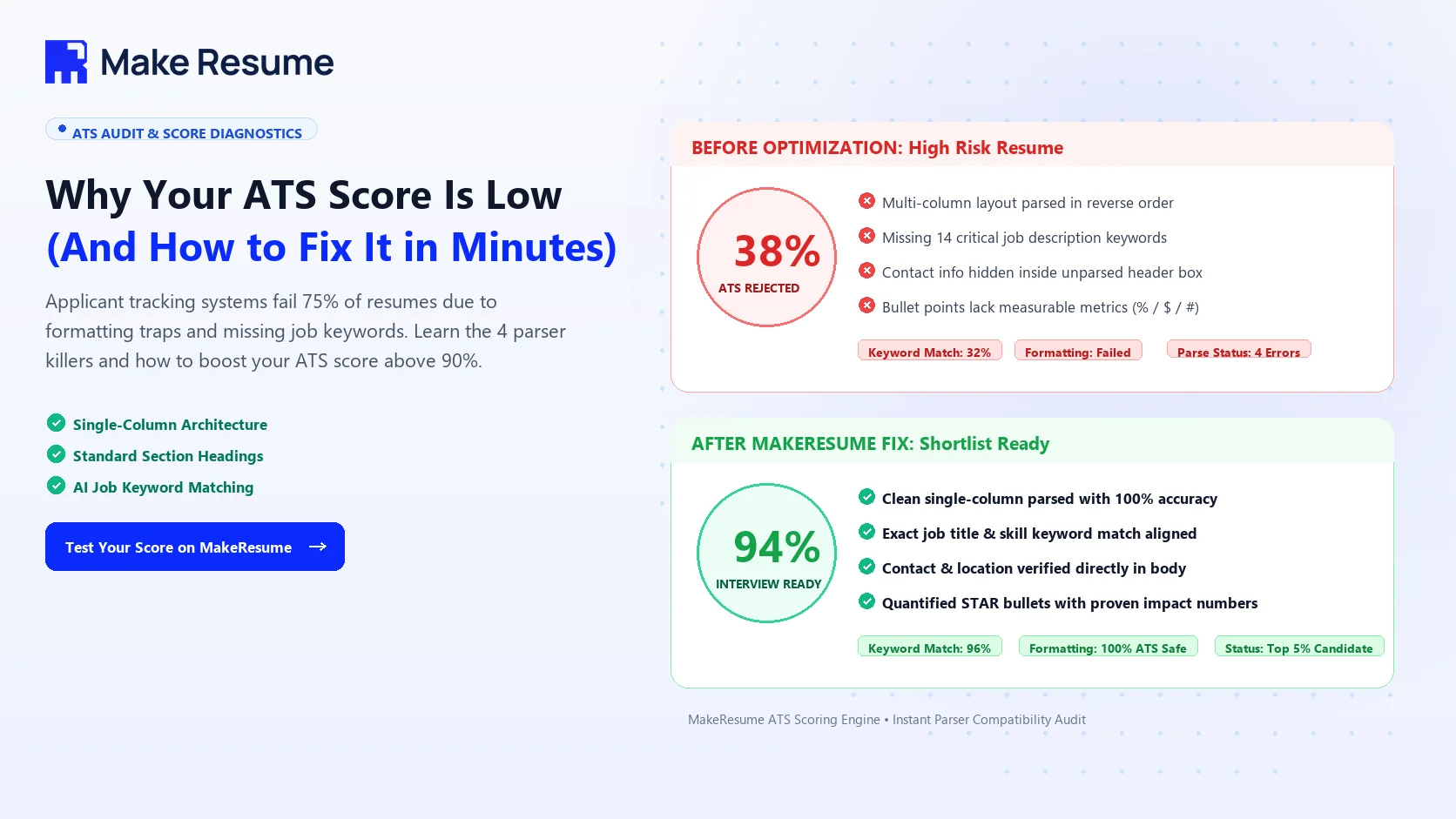
If your resume uses a multi-column design, non-standard section titles, or vague project bullet points, the parser fails to index your data properly. Understanding how ATS scoring works allows you to eliminate formatting bottlenecks, align keywords with target roles, and systematically raise your score above 80 out of 100.
The 4 Core Pillars of an ATS Score
MakeResume evaluates resumes against the four core pillars used by enterprise applicant tracking software:
1. Structure and Formatting (25 Points)
This pillar assesses whether parsing software can read your document linearly from top to bottom. ATS parsers read files line by line across horizontal coordinates. Common pitfalls include:
- Multi-column columns and sidebars that scramble text horizontally.
- Information placed inside Word or PDF headers and footers, which many parsers skip completely.
- Text boxes, graphical skill bars, tables, and circular progress meters.
- Using image-only PDFs created via scans or Photoshop rather than searchable text PDFs.
2. Section and Content Hierarchy (30 Points)
Parsers rely on standard section headings to map text into database fields. If you use creative labels like "Where I Have Contributed" instead of "Work Experience" or "Academic Projects", the system cannot categorize your entries. Required standard headings include:
- Contact Information (Name, Phone Number, Professional Email, LinkedIn, GitHub/Portfolio)
- Education (Degree, College Name, University, CGPA or Percentage, Graduation Year)
- Technical Skills (Languages, Frameworks, Developer Tools, Databases)
- Projects (Title, Tech Stack, Quantifiable Outcomes)
- Experience or Internships (Role, Organization, Duration, Location, Achievement Bullets)
3. Skills and Keyword Alignment (25 Points)
This pillar measures how closely your vocabulary mirrors the target job description or industry benchmark. If a recruiter searches for "PostgreSQL", having only "database knowledge" on your resume will fail the match query. Key factors include:
- Presence of hard technical skills (Python, Java, Spring Boot, React, Node.js).
- Acronym and full-form pairing (e.g., "Search Engine Optimization (SEO)" or "Natural Language Processing (NLP)").
- Placement of critical skills in both the dedicated Skills section and contextual project bullet points.
4. Impact and Quantifiable Metrics (20 Points)
Applicant tracking systems and human recruiters look for measurable evidence of work rather than passive task descriptions. Resumes filled with phrases like "responsible for coding" or "assisted team members" receive minimal impact scores. High scores require action verbs, scope numbers, and percentage improvements.
6 Specific Reasons Your ATS Score Is Currently Low
Reason 1: Using Multi-Column or Canva Resume Templates
Two-column templates look neat on design platforms, but they are the leading cause of low ATS scores among freshers. When an ATS parser encounters two columns, it reads across the entire horizontal page width. It reads Line 1 of Column 1, continues straight into Line 1 of Column 2, and then moves down.
The result is jumbled nonsense: your contact details blend with your summary, and your project names mix with your skill tags. Always switch to a verified single-column layout from our ATS resume templates collection before submitting applications.
Reason 2: Missing Exact-Match Technical Keywords
Automated resume scanners do not interpret synonyms reliably. If a job posting lists "RESTful APIs", writing "web services" may not trigger the match filter. Similarly, writing "MERN" instead of breaking out "MongoDB, Express.js, React, Node.js" hurts your coverage score.
To diagnose exact keyword gaps between your draft and a specific company opening, use our targeted JD resume matcher.
Reason 3: Vague Bullet Points Without Measurable Outcomes
Writing what you were assigned to do instead of what you achieved lowers both your ATS impact score and recruiter engagement.
Compare these two project descriptions:
Weak (Low ATS Impact Score):
- Worked on a full-stack e-commerce web application using React and Node.js.
- Responsible for implementing user login and database connection.
- Handled bug fixes and tested the application.
Strong (High ATS Impact Score using Google XYZ Framework):
- Built a full-stack e-commerce platform using React, Node.js, and MongoDB, supporting 500+ simulated concurrent product queries.
- Integrated JWT-based authentication and Bcrypt password hashing, reducing unauthorized session attempts to zero during security testing.
- Optimized database indexing and aggregation pipelines, decreasing API response latency by 35% across 12 endpoints.
Notice the difference: the revised bullets specify exact tools, user volumes, and measurable percentage improvements.
Reason 4: Missing Contact Essentials or Placing Details in Headers
If your resume places your phone number or email inside the document's header margin, the parser may register your file as having zero contact information. Always place your full name, phone number with country code (+91), email address, city and state, and LinkedIn profile link in the top body section of the page.
Reason 5: Non-Standard CGPA and Academic Representations
For Indian fresher placements, how you represent your marks matters. If your college awards grades on a 10-point scale, write 8.4 / 10.0 CGPA. If you write 84%, make sure the scale is unambiguous. Omitting your branch of study (e.g., Computer Engineering, Information Technology, Electronics and Telecommunication) prevents filters from confirming your eligibility against TPO criteria.
Reason 6: Generic Headline and Summary
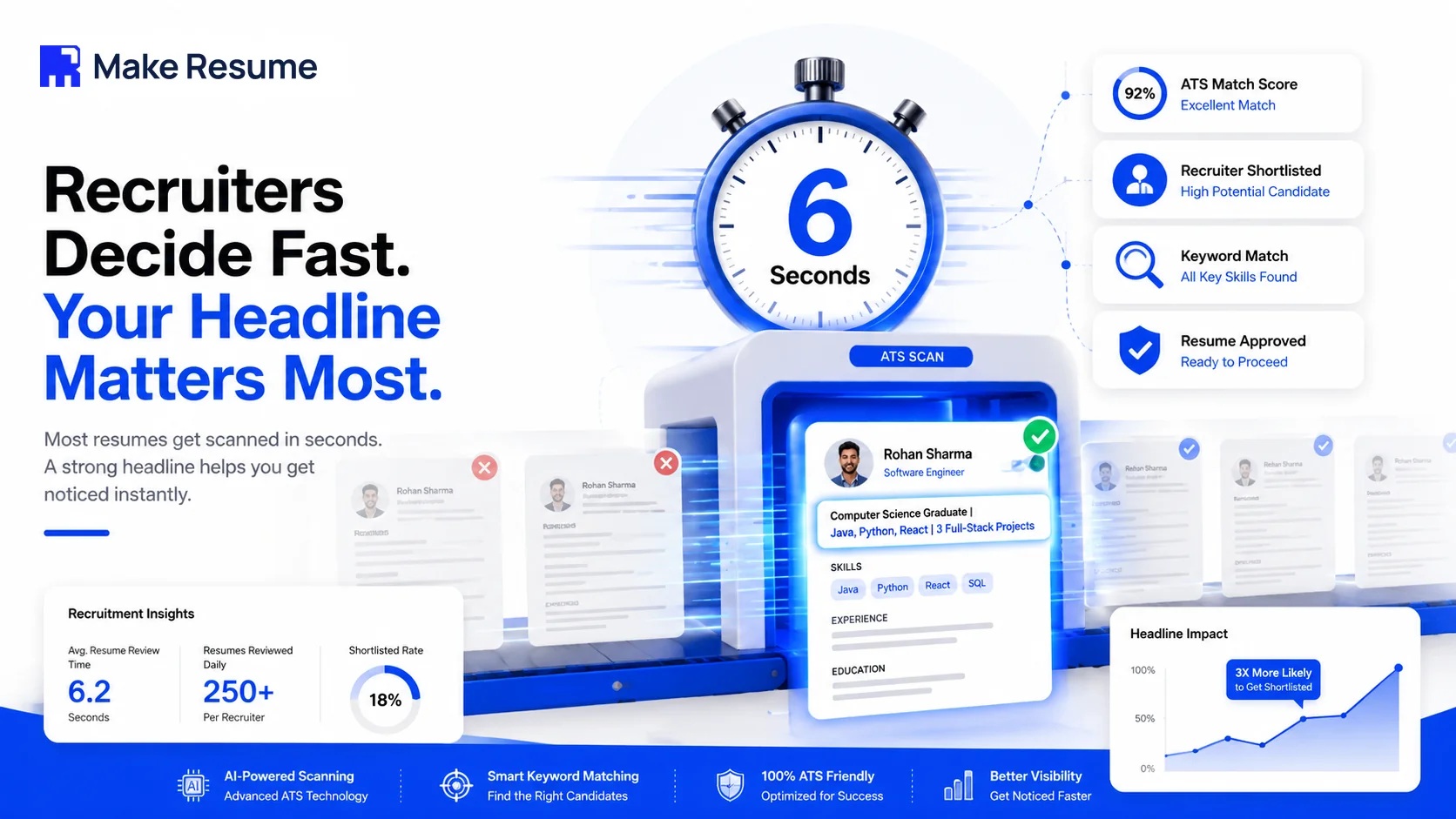
A headline that reads "Aspiring Software Engineer Seeking an Entry-Level Role" gives the parser zero keyword signals. A tailored headline like "Frontend Developer | React.js, TypeScript, Next.js | B.Tech Computer Science 2026" instantly registers four keyword points in the database.
Step-by-Step Fix: How to Raise Your Score from 50 to 85+ in 20 Minutes
Step 1: Check Current Score on MakeResume (/ats-checker)
                    │
                    ▼
Step 2: Convert Layout to Single-Column Format (/templates)
                    │
                    ▼
Step 3: Standardize Section Headings
                    │
                    ▼
Step 4: Inject Target Keywords into Skills & Projects
                    │
                    ▼
Step 5: Rewrite Experience Using Google XYZ / STAR Format
                    │
                    ▼
Step 6: Re-scan to Verify Score > 80
- Upload your current PDF or Word resume into our free ATS resume checker to get a baseline score breakdown across Structure, Content, Skills, and Impact.
- Switch to a single-column layout with standard 1-inch margins and clean sans-serif typography (such as Inter, Roboto, or Arial).
- Audit your section headings to confirm you are using exact titles: "Education", "Technical Skills", "Projects", and "Work Experience".
- Extract keywords from target job postings on Naukri, LinkedIn, or college TPO circulars and place them into your Skills matrix.
- Rewrite your top project bullets using the STAR methodology (Situation, Task, Action, Result) with numbers, percentages, and tech stack details.
- Re-scan your document to confirm your new score is above 80 before applying to companies.
Before and After: Real Fresher Resume Transformations
Example 1: Academic Final Year Project
Before (Score: 48/100):
- Final year project was an Android app for attendance tracking.
- Used Java and Firebase database.
- App allowed teachers to mark attendance and generate reports.
After (Score: 88/100):
- Developed an automated Android attendance tracking app using Java, XML, and Firebase Realtime Database for 120+ college students.
- Implemented QR-code scanning and geolocation validation, cutting manual classroom attendance logging time from 15 minutes to under 2 minutes per lecture.
- Automated weekly attendance PDF report generation and automated low-attendance email alerts to students below the 75% mandatory threshold.
Example 2: Frontend Developer Internship / Personal Project
Before (Score: 52/100):
- Created a dashboard website with HTML, CSS, and JavaScript.
- Connected APIs to show weather and user data.
- Made the site responsive for mobile phones.
After (Score: 91/100):
- Built a responsive analytics dashboard using React, Tailwind CSS, and RESTful APIs, displaying real-time metrics across 6 visual data cards.
- Integrated Axios for asynchronous API caching and state management, reducing redundant server requests by 40%.
- Achieved 98+ Google Lighthouse performance and accessibility scores across mobile, tablet, and desktop viewports.
Next Steps to Shortlist Success
Raising your ATS score gets your resume through the initial programmatic filter. Once human recruiters review your file, they look for clarity, verified technical competence, and clean presentation.
If you have already optimized your ATS score but are still waiting on interview responses, read our resume not getting shortlisted diagnostic checklist to evaluate recruiter-readability factors. For step-by-step role customization, follow our 10-minute guide to tailoring your resume to a job description.